

To weigh a hawk accurately, weigh it at the same time every day, before food, on the same scale and perch, and write the number down at once. A consistent routine makes small changes visible. Without one, a few grams of difference could come from the bird, the scale or the time of day, and you cannot tell which.[1]
The rest of this guide covers choosing and checking a scale, setting it up, the daily routine, and the mistakes that most often spoil a reading.
Choosing a scale
A falconry scale needs two things: it must read finely enough for your bird, and it must give the same answer every time.
| Bird | Typical weight | What to look for |
|---|---|---|
| Small falcons and hawks (merlin, kestrel, male sparrowhawk) | under 300 g | A reading finer than 1 g helps |
| Mid-size (peregrine, Harris's hawk, goshawk) | roughly 500 g to 1.4 kg | 1 g resolution |
| Large (eagles, eagle owls) | several kilograms | 1 g resolution and a capacity well above the bird's weight |
Most falconers use a digital platform scale with a perch or block fixed on top; it sits alongside the rest of the falconry equipment a beginner needs. Look for a stable base, a display you can read while the bird is on it, and enough capacity for the bird plus the perch.
Setting up the weighing perch
Fix the perch or block firmly to the scale so it cannot rock. Give the bird a surface it grips comfortably. Put the scale on a level, solid surface out of the wind, because a draught on a large bird can shift the reading. Then tare: with the perch on the scale and no bird, set the display to zero.
The daily routine
Consistency is the whole point. The routine below takes a few minutes and makes every weight comparable with the one before.[2]
- 1
Check the scale
Switch it on, let it settle on a level surface and confirm it reads zero. Once a week, place a known weight on it and check the reading.
- 2
Tare the perch
Put the weighing perch or block on the scale and zero it, so the display shows the bird alone.
- 3
Step the bird on calmly
Bring the bird to the perch from the glove and let it settle. A bird that bates or grips the glove gives a false reading.
- 4
Read a steady number
Wait until the reading stops moving, then note it. If it keeps drifting, step the bird off, re-zero and try again.
- 5
Log it at once
Write the weight, the time and one line on the bird's behaviour before you feed or fly.
Why before food
A meal can add tens of grams in seconds. Weighing before food shows the bird's real condition, and lets you decide how much to feed today from that number.
Why the same time
A bird loses weight steadily through the day and night. A reading at 7 in the morning and one at 11 are not the same measurement. If your schedule changes, note the time next to the weight.
Mistakes that spoil a reading
- Feeding first. Even a tidbit on the glove changes the number.
- Changing scales. Two scales can disagree by a few grams.
- Forgetting equipment. A new transmitter or a different bell looks like a gain in the bird.
- Reading too early. Wait for the display to settle while the bird stands still.
- Weighing on the glove. Holding the bird on a hand scale adds your own movement. Use a perch.
- Writing it down later. Memory rounds numbers. Log the weight before you do anything else.
Turning weights into decisions
A single weight tells you little. A run of weights, each next to a note on behaviour, shows the trend and lets you find the bird's flying window. Read what flying weight is and how to find it for how to use the numbers you now collect.
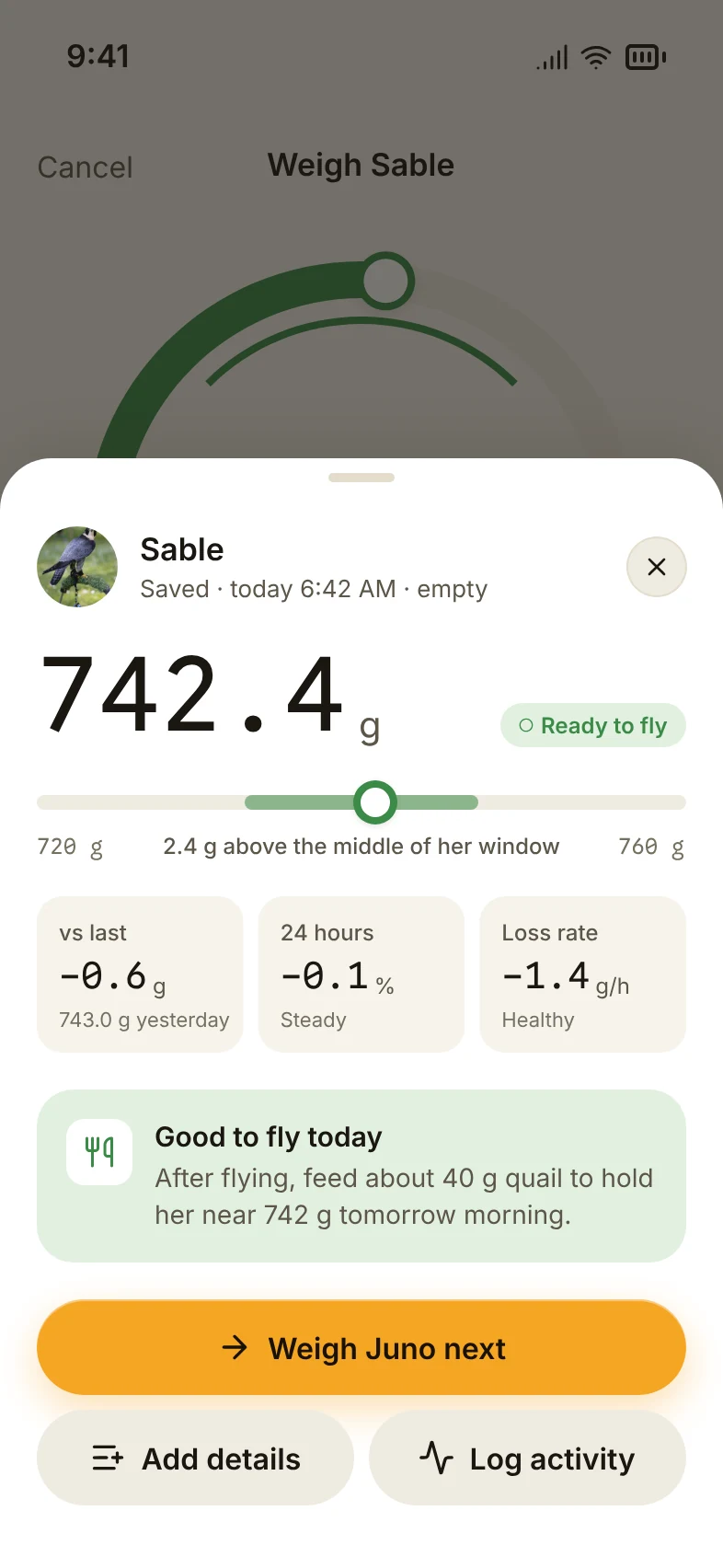
A weigh-in in Falconry Scale
In Falconry Scale, each weigh-in is checked against the bird's flying window the moment you save it, a slipped decimal is caught before it is saved, and the chart shows the trend from seven days to a year. Logging takes a few seconds, on your phone or on the web app. New to the app? Start with getting started with Falconry Scale.
Questions falconers ask
What is the best time of day to weigh a hawk?
The best time is the one you can keep every day. Most falconers weigh in the morning, before any food, after the bird has had the chance to mute and cast. If you fly in the afternoon, a second weigh-in just before flying shows you how much weight the bird has lost since the morning.
Should I weigh my hawk with jesses, bells and a transmitter on?
Either way works, as long as you are consistent. If the bird normally wears its equipment, weigh with it on every time. If you add or remove a transmitter or a heavier bell, write it down, because a few grams of equipment can look like a change in the bird.
How accurate does a falconry scale need to be?
A scale that reads to 1 gram is the usual standard. For very small birds, such as merlins, kestrels and male sparrowhawks, a finer reading helps, because a single gram is a larger share of the bird. Whatever you use, check it against a known weight regularly.
Why does my bird weigh differently on two scales?
Scales differ slightly, and cheap ones drift with temperature and battery level. Pick one scale and use it for every weigh-in. If you must change, weigh the bird on both scales the same morning and note the difference so your records stay comparable.
Sources
- [1]Understanding the Bird of Prey, Nick Fox, Hancock House, 1995
- [2]Falconry: Care, Captive Breeding and Conservation, Jemima Parry-Jones, David & Charles, 1994
- [3]Falconry training and technique, Wikipedia (accessed 2026-11-04)


