

Flying weight is the weight at which a trained bird of prey is keen to hunt, responsive to the falconer and strong enough to fly well. It is the single most useful number a falconer keeps, because a few grams either side of it change how the bird behaves more than almost anything else you control.[1]
This guide explains what flying weight means, why such small numbers matter, and a calm, repeatable way to find your own bird's window and keep it through the season.
What flying weight means
A raptor flies to the fist or the lure because it wants the food you carry. Weight is how falconers manage that appetite. Above flying weight a bird has little reason to come back: it sits in a tree, ignores the lure or wanders off after its own interests. Below it, the bird responds quickly but loses the strength and stamina it needs to chase quarry, and it has less in reserve against cold and illness.[2]
Flying weight is therefore not "as light as possible". It is the point where appetite and strength are both where you want them. Most falconers think of it as a window: a range of a few grams inside which this particular bird flies well.
Two terms help:
- Fat weight (or fed-up weight) is what the bird weighs when it is well fed and resting, for example straight out of the moult.
- Flying weight is the working range you reach from there, slowly, during manning and training.[3]
Why a few grams matter
For a 900 g falcon, 10 grams is barely more than 1 percent of its body weight. Yet that difference can decide whether the bird waits on overhead or drifts off downwind. Smaller birds are even more sensitive: on a merlin or a kestrel, a handful of grams is a large share of the whole bird.
That is why falconers weigh to the gram, and why a chart of the last few weeks says more than any single reading.
Sable · peregrine · 30 days
892.4g
How to find it, step by step
There is no table that gives you your bird's flying weight. Species averages, like those in our guide to falcon species, help you sanity-check, but two birds of the same species and sex can fly well tens of grams apart. You find the window by watching your own bird.
- 1
Weigh every morning
Use the same scale and perch at the same time each day, before food, and write the weight down before anything else.
- 2
Note the behaviour next to the number
One line is enough. Keen, slow to come, ignoring the lure, footing hard, tired at the end of the session.
- 3
Find the window
After two to three weeks of records, the days your bird flew best cluster around a few grams. That cluster is the window.
- 4
Hold it, then adjust
Feed to stay inside the window, and expect to move it with cold weather, rising fitness and the moult.
Write the behaviour down every time. "Came straight away, footed the lure hard" next to 892 g is worth far more than the number alone. After a few weeks, a pattern appears: the days your bird was sharp and keen sit inside a narrow band. That band is your window.
Signs you are close
- The bird watches you and the glove closely, and comes without hesitation.
- It takes food readily but is not frantic or screaming.
- It flies with power to the end of the session.
Signs you have gone too low
- Weak or short flights, and tiring early.
- Sitting fluffed up, sleepy or dull.
- Less interest in food, not more.
If you see the second list, feed up and give the bird time. Ask an experienced falconer or an avian vet if you are unsure. If you are new to the sport, read how to start falconry first: finding flying weight is a skill you learn beside a mentor.
Check it with the calculator
Use this to see how far today's weight sits from your bird's flying weight, in grams and as a percentage.
How far from flying weight?
+0.8%7.4 g above flying weight.
A guide, not advice. Every bird is different.
Reading it in the app
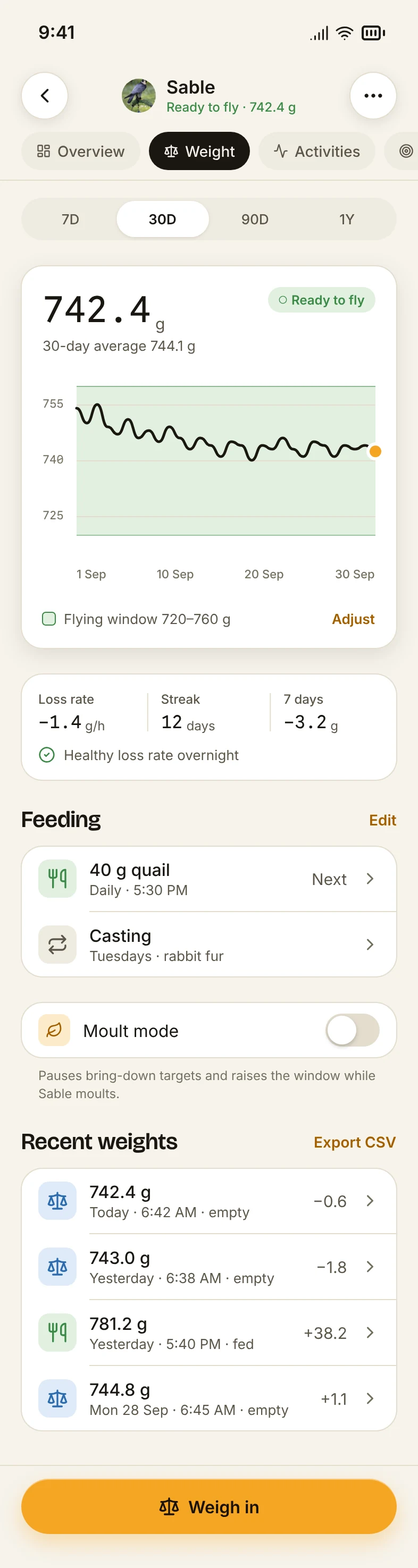
The weight tab in Falconry Scale
Falconry Scale keeps each bird's flying window behind every chart, so a new weigh-in tells you at a glance whether the bird is above, inside or below it. A bring-down plan keeps any planned drop to no more than 1.5 percent a day over at least seven days, and the app warns you about a sudden drop. See every weight feature on the features page.
If you are new to weighing, read how to weigh a hawk accurately next: a consistent routine matters as much as the number itself. To start logging, follow getting started with Falconry Scale.
Questions falconers ask
Is flying weight the same as hunting weight?
Many falconers use the two words for the same thing. Some keep a hunting weight a few grams below their everyday flying weight for harder quarry or bad weather. What matters is that you write down which one you mean, and that you reach either one slowly and only for a bird that is fit and healthy.
How much weight does a hawk lose to reach flying weight?
There is no single percentage that is right for every bird. It depends on the species, the individual, how fat the bird was at the start and its fitness. Experienced falconers bring a bird down slowly over days or weeks and let the bird's behaviour, not a target figure from a table, tell them when they are close.
How often should I weigh my bird?
Every day, at the same time, before feeding. On flying days some falconers also weigh after the session to learn how much the bird uses in work. Daily weighing is the only way to see a trend early, before it shows in how the bird flies.
Does flying weight change during the year?
Yes. Cold nights burn more energy, so many birds need to be flown a little heavier in winter. Fitness and experience often let a bird fly well at a higher weight as the season goes on, and the moult is usually managed at a much higher weight. Recheck the window whenever conditions change.
Sources
- [1]Understanding the Bird of Prey, Nick Fox, Hancock House, 1995
- [2]Falconry: Care, Captive Breeding and Conservation, Jemima Parry-Jones, David & Charles, 1994
- [3]Falconry training and technique, Wikipedia (accessed 2026-11-04)


